
Home › Hair transplant for men
Hair transplant · Men
Hair transplant for men in Panamá
Restore your hairline with the DHI technique: follicle by follicle, no scalpel, natural results.
Message us on WhatsApp
Restore your hairline with the DHI technique: follicle by follicle, no scalpel, natural results.
Message us on WhatsAppA hair transplant relocates the healthiest, genetically resistant follicles from the donor area —the back of the head— to areas with hair loss. Because those follicles are resistant to shedding, the result is permanent. It's an excellent solution for most types of hair loss in men.


Direct Hair Implantation (DHI) is performed in two phases. In extraction, follicles are removed one by one with a disposable tool that keeps them intact. In implantation, they are placed directly with the DHI-patented implanter, with full control of depth, direction and angle, for a natural-looking result.
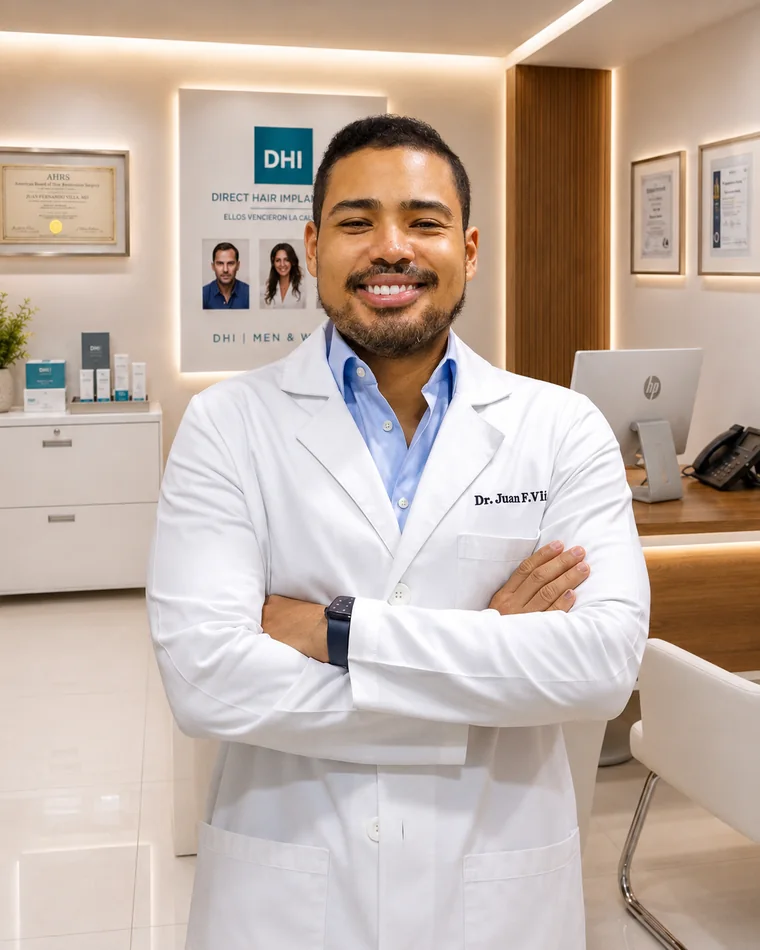
Medical Director · DHI Panamá
Dr. Juan Vlieg is one of the leading names in DHI hair restoration in Panamá and Latin America. He holds certifications from the American Board of Hair Restoration Surgery (ABHRS) and the International Society of Hair Restoration Surgery (ISHRS), which back his experience, training and commitment to the highest standards of hair medicine.
Throughout his career he has performed thousands of hair transplant procedures, focused on natural, harmonious results tailored to each patient's characteristics.
His medical philosophy rests on three core principles: an honest diagnosis, a fully personalized plan and the pursuit of the most natural result possible. That is why Dr. Vlieg personally takes part in the consultation, designs the hairline and performs every implantation procedure.
The price is based on the number of hairs you need, with a minimum investment of $3,000 per procedure. Message us on WhatsApp for a clear figure.
Request an assessmentLooking to restore your density? We have a solution designed for you.
A hair transplant is a medical procedure in which healthy follicles are moved from a donor area, usually the back or sides of the head, to areas with loss or reduced density. Follicles can be extracted individually with FUE or via a strip of tissue in the FUT method. They are then implanted in the recipient area following a design that respects the angle, direction and natural distribution of the hair. The procedure redistributes the available hair; it does not create new follicles. That is why the quality and quantity of hair in the donor area are key to determining the possible result.
Before choosing a clinic, you should consider the cause and degree of hair loss, the quality of the donor area, the approximate number of grafts needed and how the hair loss may progress in the future. It is also important to confirm that the procedure is led by a physician trained in hair restoration, to know who will perform the extraction and implantation, to review results from patients with similar characteristics, and to confirm there is follow-up after surgery. The physician's experience is especially important to avoid problems such as over-harvesting the donor area. You should also weigh the total cost, medication, follow-up visits, accommodation and the time needed to stay in Panama. At DHI Panamá, the plan is set after an individual medical evaluation and the procedure is performed under international hair-restoration protocols.
A good candidate generally has correctly diagnosed hair loss, a donor area with enough healthy follicles and realistic expectations about the density that can be achieved. The evaluation looks at the pattern of hair loss, the density and stability of the donor area, hair characteristics, scalp health, medical history and how the loss may progress. Age alone does not determine candidacy, but in younger patients it is especially important to plan for how the hair loss might advance over time. Not every cause of hair loss is treated with a transplant. Some active, inflammatory or scarring alopecias may first require medical diagnosis and treatment. Final candidacy can only be established after an in-person consultation or a complete medical evaluation.
In a DHI transplant, follicles are also extracted individually with FUE, without removing a strip of scalp and without leaving a linear scar. The main difference lies in the implantation stage. In many conventional FUE procedures, small incisions or channels are first made in the recipient area with needles or blades. The grafts are then inserted manually into those channels, often with forceps. With the DHI technique, each follicle is carefully loaded into a special implanter. This instrument creates the recipient site and places the graft in a controlled way, letting the physician set the depth, angle and growth direction of each hair individually. This method can offer important advantages:
• Less direct handling of the follicle during placement.
• Greater control of angle, direction and depth.
• Precise implantation between existing hairs.
• More detailed distribution of the grafts.
• A more natural frontal hairline design.
• No linear scar in the donor area.
Follicles are delicate structures. Excessive pressure with forceps, incorrect placement or prolonged handling can injure them and affect their survival. The DHI implanter is designed to allow gentle, controlled placement; however, the result depends mainly on the medical team's preparation, correct handling of the grafts and the planning of each case. By comparison, the FUT method requires removing a strip of scalp from the donor area and usually leaves a linear scar. FUE and DHI extract follicles one by one, but DHI adds a direct-implantation system that aims to increase precision and reduce unnecessary handling of the grafts. At DHI Panamá, this technique makes it possible to control the placement of each follicle to pursue a natural hairline, even distribution and proper integration with the existing hair.
An honest consultation is the start. Message us today and tell us about your case.
Message us on WhatsApp


